New York, USA, May 20, 2026 (GLOBE NEWSWIRE) -- ESR1-Mutated Metastatic Breast Cancer Market Expected to Grow Rapidly at 9.6% CAGR During the Forecast Period (2026–2036) Due to the Emergence of Novel Oral SERDs and Targeted Agents | DelveInsight
The ESR1 Mutated metastatic breast cancer market is witnessing significant growth driven by the rising prevalence of endocrine-resistant HR-positive/HER2-negative breast cancer and increasing adoption of precision oncology approaches. The emergence of novel therapies such as Giredestrant (Roche/Genentech), Camizestrant (AZD9833) (AstraZeneca), Palazestrant (OP-1250) (Olema Pharmaceuticals), Lasofoxifene (Sermonix Pharmaceuticals), AND-019 (Kind Pharmaceuticals), H3B-6545 (Eisai), and others is reshaping the treatment landscape and expanding commercial opportunities.
Recently published ESR1 Mutated Metastatic Breast Cancer Market Insights report includes a comprehensive understanding of current treatment practices, emerging ESR1 mutated metastatic breast cancer drugs, market share of individual therapies, and current and forecasted ESR1 mutated metastatic breast cancer market size from 2022 to 2036, segmented into leading markets (the US, EU4, UK, and Japan).
ESR1 Mutated Metastatic Breast Cancer Market Summary
- The total ESR1 mutated metastatic breast cancer treatment market size was found to be USD 1.5 billion in the leading markets.
- The United States accounts for the largest market size of ESR1 mutated metastatic breast cancer, in comparison to EU4 (Germany, Italy, France, and Spain), the UK, and Japan.
- About 40% of advanced breast cancer patients develop ESR1 mutations during first-line therapy, reducing treatment effectiveness.
- The total number of diagnosed prevalent cases of HR positive breast cancer in the 7MM was nearly 1.3 million in 2025.
- Key ESR1 mutated metastatic breast cancer companies, including Roche, Genentech, AstraZeneca, Olema Pharmaceuticals, Sermonix Pharmaceuticals, Kind Pharmaceuticals, Eisai, and others, are actively working on innovative ESR1 mutated metastatic breast cancer drugs.
- Some of the key ESR1 mutated metastatic breast cancer therapies in clinical trials include Giredestrant, Camizestrant (AZD9833), Palazestrant (OP-1250), Lasofoxifene, AND-019, H3B-6545, and others. These novel ESR1 mutated metastatic breast cancer therapies are anticipated to enter the ESR1 mutated metastatic breast cancer market in the forecast period and are expected to change the market.
Discover how big is the ESR1 metastatic breast cancer market @ https://www.delveinsight.com/sample-request/esr1-mutated-metastatic-breast-cancer-market
According to Sadaf Javed, an oncology expert at DelveInsight, there is a need for new ET agents with strong and durable activity in heavily treated patients, including after standard-of-care first-line therapy with CDK4/6 inhibitors and in those with ESR1 mutations.
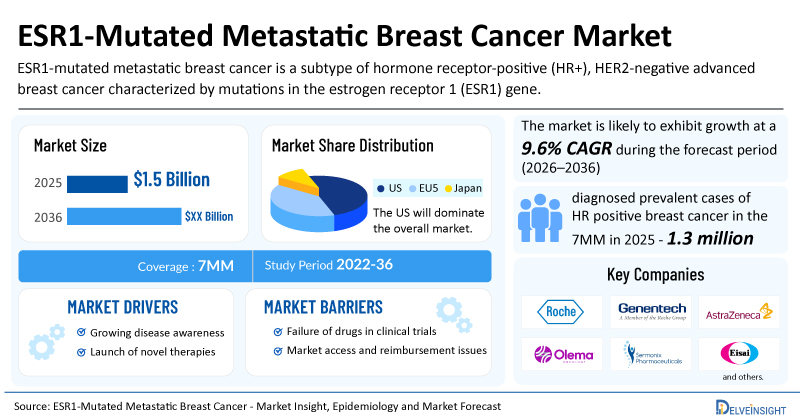
Key Factors Driving the Growth of the ESR1 Mutated Metastatic Breast Cancer Market
- Increasing Prevalence of ESR1 Mutations: ESR1 mutations are increasingly detected in patients receiving long-term endocrine therapies, especially aromatase inhibitors. Studies indicate that approximately 20–40% of HR+/HER2-negative metastatic breast cancer patients exposed to aromatase inhibitors develop ESR1 mutations, making this a clinically significant patient population.
- Rising Incidence of Endocrine Therapy Resistance: ESR1 mutations enable tumor cells to grow independently of estrogen signaling, leading to resistance against conventional endocrine therapies. As resistance rates increase, oncologists are shifting toward targeted treatment strategies, fueling demand for next-generation therapies such as oral SERDs.
- Entry of VEPPANU in the ESR1 Mutated Metastatic Breast Cancer Market: The launch of VEPPANU (vepdegestrant) represents a landmark shift in the ESR1-mutated metastatic breast cancer market, as it is the first-ever FDA-approved PROTAC (PROteolysis TArgeting Chimera) therapy, introducing an entirely novel mechanism of targeted protein degradation into oncology.
- Advancements in Liquid Biopsy and NGS Testing: Growing adoption of liquid biopsy and next-generation sequencing (NGS) technologies has improved early and non-invasive detection of ESR1 mutations. Circulating tumor DNA (ctDNA)-based testing enables real-time monitoring of resistance mutations, supporting precision treatment decisions and increasing diagnostic testing demand.
- Launch of Emerging Therapies: The dynamics of the ESR1 mutated metastatic breast cancer market are expected to change in the coming years due to the launch of emerging therapies such as Giredestrant (Roche/Genentech), Camizestrant (AZD9833) (AstraZeneca), Palazestrant (OP-1250) (Olema Pharmaceuticals), Lasofoxifene (Sermonix Pharmaceuticals), AND-019 (Kind Pharmaceuticals), H3B-6545 (Eisai), and others.
ESR1 Mutated Metastatic Breast Cancer Market Analysis
- Current treatment guidelines for ER-positive metastatic breast cancer do not currently stratify patients according to ESR1 mutation status.
- While multiple preclinical studies have shown reduced sensitivity of ESR1-mutant cells to fulvestrant, retrospective analyses from the PALOMA-2 trial revealed that patients receiving fulvestrant, either as monotherapy or in combination with palbociclib, continued to develop the Y537S ESR1 mutation during treatment.
- Recent progress in the ESR1-mutated MBC space, including the approvals of INLURIYO and ORSERDU, is expanding therapeutic options aimed at overcoming endocrine resistance.
- In parallel, early diagnostic approaches and intervention strategies, such as switching to camizestrant, have demonstrated the potential to nearly double progression-free survival, significantly transforming the treatment paradigm.
- Recently, Arnivas and Pfizer’s VEPPANU (vepdegestrant) received FDA approval for adults with estrogen receptor-positive (ER+)/human epidermal growth factor receptor 2-negative (HER2-) advanced or metastatic breast cancer harboring ESR1 mutations, as identified through an FDA-authorized test, following disease progression after at least one prior endocrine therapy. Notably, this decision represents the FDA’s first approval of a PROteolysis TArgeting Chimera (PROTAC) therapy, introducing a new class of heterobifunctional protein degraders into clinical practice.
- Additionally, several emerging therapies, including Giredestrant (Roche/Genentech), Camizestrant (AZD9833) (AstraZeneca), Palazestrant (OP-1250) (Olema Pharmaceuticals), Lasofoxifene (Sermonix Pharmaceuticals), AND-019 (Kind Pharmaceuticals), H3B-6545 (Eisai), and others, are expected to further redefine the treatment landscape for ESR1-mutated metastatic breast cancer.
Learn more about the future market of SERDs in breast cancer @ ESR1 Mutated Metastatic Breast Cancer Treatment Market
ESR1 Mutated Metastatic Breast Cancer Competitive Landscape
Some of the ESR1 mutated metastatic breast cancer drugs under development include Giredestrant (Roche/Genentech), Camizestrant (AZD9833) (AstraZeneca), Palazestrant (OP-1250) (Olema Pharmaceuticals), Lasofoxifene (Sermonix Pharmaceuticals), AND-019 (Kind Pharmaceuticals), H3B-6545 (Eisai), and others.
Roche’s Giredestrant is an investigational, orally administered next-generation selective oestrogen receptor degrader (SERD) and complete ER antagonist. It is engineered to inhibit oestrogen binding to the oestrogen receptor, promote receptor degradation, and consequently suppress or delay the proliferation of cancer cells. Giredestrant is supported by a broad clinical development programme, with five company-sponsored Phase III trials currently evaluating its potential across multiple treatment settings and lines of therapy to expand its benefit to a wider patient population.
AstraZeneca’s Camizestrant is an oral selective estrogen receptor degrader (SERD) that has demonstrated antitumor activity across multiple preclinical breast cancer models. The therapy has received both Fast Track Designation (FTD) and Breakthrough Therapy Designation (BTD) in the US for first-line HR+/HER2− ESR1-mutated metastatic breast cancer (MBC). It is currently being investigated in the pivotal Phase III SERENA-6 trial in the same setting.
Olema Pharmaceuticals’ Palazestrant is a small-molecule complete estrogen receptor antagonist (CERAN) that has secured FDA Fast Track Designation for ER+/HER2− metastatic breast cancer progressing after endocrine therapy, including CDK4/6 inhibitors. The agent is under evaluation in the Phase III OPERA-01 trial as a monotherapy in second-/third-line MBC and in OPERA-02 in combination with ribociclib for first-line MBC. Palazestrant has demonstrated encouraging potential in both ESR1-mutant and ESR1 wild-type ER+/HER2− tumors.
The US commercial launch of palazestrant is anticipated in 2027 for the second-/third-line setting and in 2029 for first-line treatment. Topline data from OPERA-01 are expected in H2 2026, while OPERA-02 results are projected for 2028.
The anticipated launch of these emerging therapies are poised to transform the ESR1 mutated metastatic breast cancer market landscape in the coming years. As these cutting-edge therapies continue to mature and gain regulatory approval, they are expected to reshape the ESR1 mutated metastatic breast cancer market landscape, offering new standards of care and unlocking opportunities for medical innovation and economic growth.
To know more about which companies are leading ESR1 metastatic breast cancer pipeline, visit @ ESR1 Mutated Metastatic Breast Cancer Medication
Recent Developments in the ESR1 Mutated Metastatic Breast Cancer Market
- In May 2026, the FDA approved VEPPANU (vepdegestrant) for adults with estrogen receptor-positive (ER+)/human epidermal growth factor receptor 2-negative (HER2-) advanced or metastatic breast cancer harboring ESR1 mutations, as identified through an FDA-authorized test, following disease progression after at least one prior endocrine therapy.
- In April 2026, the FDA’s Oncologic Drugs Advisory Committee did not achieve a majority vote supporting the benefit-risk profile of AstraZeneca’s camizestrant combined with a cyclin-dependent kinase (CDK) 4/6 inhibitor (palbociclib, ribociclib, or abemaciclib) as a first-line treatment for patients with hormone receptor (HR)-positive, HER2-negative advanced breast cancer harboring emergent ESR1 mutations, based on findings from the Phase III SERENA-6 trial. The committee voted 3–6 against the proposal.
- In February 2026, Roche announced that the FDA had accepted the new drug application (NDA) for giredestrant, an investigational oral therapy, to be used in combination with everolimus for the treatment of adult patients with ER-positive, HER2-negative, ESR1-mutated locally advanced or metastatic breast cancer that has progressed following prior endocrine therapy.
- In October 2025, Olema Pharmaceuticals announced that they presented a trial-in-progress poster for the Phase III OPERA-02 trial at the SABCS 2025.
- In September 2025, Eli Lilly and Company announced that the FDA approved INLURIYO for the treatment of adults with ER+, HER2–, ESR1-mutated advanced or MBC whose disease progressed after at least one line of endocrine therapy.
What is ESR1 Mutated Metastatic Breast Cancer?
ESR1-mutated metastatic breast cancer is a subtype of hormone receptor-positive (HR+), HER2-negative advanced breast cancer characterized by mutations in the estrogen receptor 1 (ESR1) gene. These mutations typically emerge after prolonged exposure to endocrine therapies such as aromatase inhibitors and can lead to resistance by enabling the estrogen receptor to remain active even in low-estrogen environments. ESR1 mutations are most commonly detected in metastatic settings, particularly in patients whose disease has progressed following prior hormonal treatment. Clinically, the presence of ESR1 mutations is associated with reduced responsiveness to standard endocrine therapies, making molecular testing increasingly important for treatment selection.
ESR1 Mutated Metastatic Breast Cancer Epidemiology Segmentation
The ESR1 mutated metastatic breast cancer epidemiology section provides insights into the historical and current ESR1 mutated metastatic breast cancer patient pool and forecasted trends for the leading markets. The total number of prevalent cases of breast cancer in the US was nearly 1.1 million in 2025.
The ESR1 mutated metastatic breast cancer market report proffers epidemiological analysis for the study period 2022–2036 in the leading markets segmented into:
- Total Diagnosed Prevalent Cases of HR Positive Breast Cancer
- Stage-specific Diagnosed Prevalent Cases of HR Positive Breast Cancer
- Total Diagnosed Prevalent Cases of Metastatic Breast Cancer
- Diagnosed Prevalent Cases of ESR1-mutated Metastatic Breast Cancer
- Line-wise Treatable Cases of ESR1-mutated Metastatic Breast Cancer
Download the report to understand ESR1 mutant breast cancer patient pool @ ESR1 Mutated Metastatic Breast Cancer Prevalence
| ESR1 Mutated Metastatic Breast Cancer Market Report Metrics | Details |
| Study Period | 2022–2036 |
| ESR1 Mutated Metastatic Breast Cancer Market Report Coverage | 7MM [The United States, the EU-4 (Germany, France, Italy, and Spain), the United Kingdom, and Japan] |
| ESR1 Mutated Metastatic Breast Cancer Market CAGR | 9.6% |
| ESR1 Mutated Metastatic Breast Cancer Market Size in 2025 | USD 1.5 Billion |
| Key ESR1 Mutated Metastatic Breast Cancer Companies | Roche, Genentech, AstraZeneca, Olema Pharmaceuticals, Sermonix Pharmaceuticals, Kind Pharmaceuticals, Eisai, Stemline Therapeutics (Menarini Group), Eli Lilly and Company, Arvinas, Pfizer, and others |
| Key ESR1 Mutated Metastatic Breast Cancer Therapies | Giredestrant, Camizestrant (AZD9833), Palazestrant (OP-1250), Lasofoxifene, AND-019, H3B-6545, INLURIYO, ORSERDU, VEPPANU, and others |
Scope of the ESR1 Mutated Metastatic Breast Cancer Market Report
- ESR1 Mutated Metastatic Breast Cancer Therapeutic Assessment: ESR1 Mutated Metastatic Breast Cancer current marketed and emerging therapies
- ESR1 Mutated Metastatic Breast Cancer Market Dynamics: Conjoint Analysis of Emerging ESR1 Mutated Metastatic Breast Cancer Drugs
- Competitive Intelligence Analysis: SWOT analysis and Market entry strategies
- ESR1 Mutated Metastatic Breast Cancer Market Unmet Needs, KOL’s views, Analyst’s views, ESR1 Mutated Metastatic Breast Cancer Market Access and Reimbursement
Discover more about best emerging drugs for ESR1 mutated metastatic breast cancer @ ESR1 Mutated Metastatic Breast Cancer Clinical Trials
Table of Contents
| 1 | ESR1 Mutated Metastatic Breast Cancer Market Key Insights |
| 2 | ESR1 Mutated Metastatic Breast Cancer Market Report Introduction |
| 3 | Executive Summary of ESR1-mutated Metastatic Breast Cancer |
| 4 | Epidemiology and Market Forecast Methodology |
| 5 | Key Events |
| 6 | ESR1-mutated Metastatic Breast Cancer Market Overview at a Glance |
| 6.1 | Market Share (%) Distribution by Therapies in 2025 |
| 6.2 | Market Share (%) Distribution by Therapies in 2036 |
| 7 | Disease Background and Overview |
| 7.1 | Introduction |
| 7.2 | ESR1 Mutations |
| 7.3 | Endocrine therapy |
| 7.4 | Diagnosis |
| 7.5 | Treatment and Management |
| 8 | Epidemiology and Patient Population of the 7MM |
| 8.1 | Key Findings |
| 8.1.1 | Epidemiology Assumptions and Rationale |
| 8.2 | Total Diagnosed Prevalent Cases of HR Positive Breast Cancer in the 7MM |
| 8.3 | Total Diagnosed Prevalent Population of ESR1-mutated Metastatic Breast Cancer in the 7MM |
| 8.3.1 | Total Diagnosed Prevalent Population of ESR1-mutated Metastatic Breast Cancer in 1L in the 7MM |
| 8.3.2 | Total Diagnosed Prevalent Population of ESR1-mutated Metastatic Breast Cancer in 2L and above in the 7MM |
| 8.4 | The United States |
| 8.4.1 | Stage-specific Diagnosed Prevalent Cases of HR+ Breast Cancer in the United States |
| 8.4.2 | Total Diagnosed Prevalent Cases of Metastatic Breast Cancer in the United States |
| 8.4.3 | Diagnosed Prevalent Cases of ESR1-mutated Metastatic Breast Cancer in the United States |
| 8.5 | EU4 and the UK |
| 8.6 | Japan |
| 9 | ESR1 Mutated Metastatic Breast Cancer Patient Journey |
| 10 | Marketed ESR1 Mutated Metastatic Breast Cancer Drug |
| 10.1 | Key Cross Competition |
| 10.2 | ORSERDU (elacestrant): Stemline Therapeutics (Menarini Group) |
| 10.2.1 | Product Description |
| 10.2.2 | Regulatory Milestones |
| 10.2.3 | Other Developmental Activity |
| 10.2.4 | Clinical Development |
| 10.2.5 | Safety and Efficacy |
| 10.2.6 | Analyst’s View |
| 10.3 | INLURIYO (imlunestrant): Eli Lilly and Company |
| List to be continued… | |
| 11 | Emerging ESR1 Mutated Metastatic Breast Cancer Therapies |
| 11.1 | Key Cross Competition |
| 11.2 | Giredestrant (RG6171, GDC-9545): Genentech |
| 11.2.1 | Product Description |
| 11.2.2 | Other Developmental Activities |
| 11.2.3 | Clinical Development |
| 11.2.4 | Safety and Efficacy |
| 11.2.5 | Analyst’s View |
| 11.3 | Camizestrant (AZD9833): AstraZeneca |
| 11.4 | Lasofoxifene: Sermonix Pharmaceuticals |
| 11.5 | Palazestrant (OP-1250): Olema Pharmaceuticals |
| List to be continued… | |
| 12 | ESR1-mutated Metastatic Breast Cancer Market: The 7MM Analysis |
| 12.1 | Key Findings |
| 12.2 | ESR1-mutated Metastatic Breast Cancer Market Outlook |
| 12.3 | Conjoint Analysis |
| 12.4 | Key ESR1-mutated Metastatic Breast Cancer Market Forecast Assumptions |
| 12.5 | Total Market Size of ESR1-mutated Metastatic Breast Cancer in the 7MM |
| 12.6 | United States ESR1-mutated Metastatic Breast Cancer Market Size |
| 12.6.1 | Total Market Size of ESR1-mutated Metastatic Breast Cancer |
| 12.6.2 | Market Size of ESR1-mutated Metastatic Breast Cancer by First-Line Therapies |
| 12.6.3 | Market Size of ESR1-mutated Metastatic Breast Cancer by Second-line and above Therapies |
| 12.7 | EU4 and the UK ESR1-mutated Metastatic Breast Cancer Market Size |
| 12.8 | Japan ESR1-mutated Metastatic Breast Cancer Market Size |
| 13 | ESR1-mutated Metastatic Breast Cancer Market Unmet Needs |
| 14 | ESR1-mutated Metastatic Breast Cancer Market SWOT Analysis |
| 15 | KOL Views on ESR1-mutated Metastatic Breast Cancer |
| 16 | ESR1-mutated Metastatic Breast Cancer Market Access and Reimbursement |
| 16.1 | United States |
| 16.2 | EU4 and the UK |
| 16.3 | Japan |
| 16.4 | Summary and Comparison of Market Access and Pricing Policy Developments in 2025 |
| 16.5 | ESR1-mutated Metastatic Breast Cancer: Market Access and Reimbursement |
| 17 | Bibliography |
| 18 | ESR1-mutated Metastatic Breast Cancer Market Report Methodology |
Related Reports
ESR1 Mutated Metastatic Breast Cancer Clinical Trial Analysis
ESR1 Mutated Metastatic Breast Cancer Pipeline Insight – 2026 report provides comprehensive insights about the pipeline landscape, pipeline drug profiles, including clinical and non-clinical stage products, and the key ESR1 mutated metastatic breast cancer companies including Roche, Genentech, AstraZeneca, Olema Pharmaceuticals, Sermonix Pharmaceuticals, Kind Pharmaceuticals, Eisai, Stemline Therapeutics (Menarini Group), Eli Lilly and Company, Arvinas, Pfizer, and others.
SERD Market Size, Target Population, Competitive Landscape & Market Forecast – 2036 report deliver an in-depth understanding of the market share of the individual therapies, and key SERD companies including Stemline Therapeutics, Roche, AstraZeneca, Eli Lilly, and others.
PROTAC Market Size, Target Population, Competitive Landscape & Market Forecast – 2036 report delivers an in-depth understanding of the market trends, market drivers, market barriers, and key PROTAC companies, including Arvinas, Pfizer, BMS, Hinova Pharmaceuticals, Accutar Biotech, Nurix Therapeutics, Dialectic Therapeutics, Kymera, Sanofi, and others.
Metastatic HR+/HER2− Breast Cancer Market
Metastatic HR+/HER2− Breast Cancer Market Insights, Epidemiology, and Market Forecast – 2036 report deliver an in-depth understanding of the disease, historical and forecasted epidemiology, market share of the individual therapies, and key breast cancer companies including Merck, Arvinas, Olema Pharmaceuticals, Celcuity, Roche, AstraZeneca, Daiichi Sankyo, Eli Lilly, Sermonix Pharmaceuticals, Genentech, Veru Pharma, DualityBio, BioNtech, Evgen Pharma, Carrick Therapeutics, EQRx, G1 Therapeutics, Immutep, and others.
Metastatic HER2-Positive Breast Cancer Market
Metastatic HER2-Positive Breast Cancer Market Insights, Epidemiology, and Market Forecast – 2036 report deliver an in-depth understanding of the disease, historical and forecasted epidemiology, market share of the individual therapies, and key metastatic HER2-positive breast cancer companies including Byondis, Roche, Ambrx, Zymeworks, Jazz Pharmaceuticals, Pfizer, and others.
About DelveInsight
DelveInsight is a leading Business Consultant and Market Research firm focused exclusively on life sciences. It supports pharma companies by providing comprehensive end-to-end solutions to improve their performance. Get hassle-free access to all the healthcare and pharma market research reports through our subscription-based platform PharmDelve.

Contact Us

Shruti Thakur

info@delveinsight.com

+14699457679

www.delveinsight.com